🧑💼 Beratung: Lokale KI-Anwendungen betreiben: privat und unter eigener Kontrolle
- 🤖 Überblick: lokale Ausführung von KI-Modellen statt Cloud-Diensten
- 🔐 Vorteile: Datenschutz, Kontrolle über Daten und Modelle
- 💻 Hardwareanforderungen (CPU, GPU, RAM, Speicher)
- 📦 Installation von lokalen KI-Tools und Modell-Runnern
- 🧠 Auswahl und Nutzung verschiedener Sprachmodelle
- 🖥️ Nutzung über lokale Webinterfaces oder Desktop-Anwendungen
- 🔌 Integration mit eigenen Workflows und Anwendungen
- ⚙️ Modellverwaltung, Updates und Ressourcenoptimierung
- 🛡️ Best Practices für sichere und private Nutzung
Self-organized stochastic tipping in slow-fast dynamical systems
Mathias Linkerhand, Claudius Gros
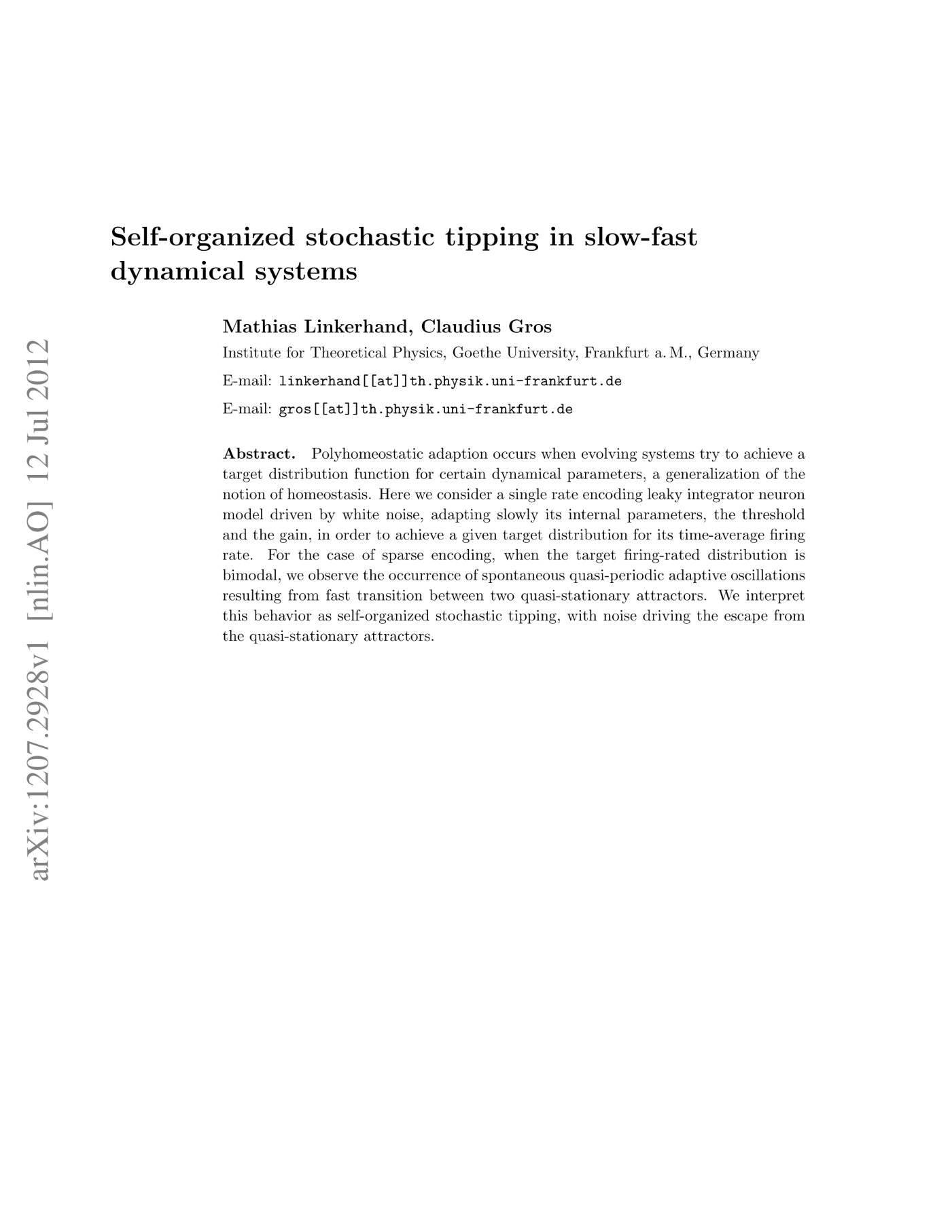
Polyhomeostatic adaption occurs when evolving systems try to achieve a target distribution function for certain dynamical parameters, a generalization of the notion of homeostasis. Here we consider a single rate encoding leaky integrator neuron model driven by white noise, adapting slowly its internal parameters, the threshold and the gain, in order to achieve a given target distribution for its time-average firing rate. For the case of sparse encoding, when the target firing-rated distribution is bimodal, we observe the occurrence of spontaneous quasi-periodic adaptive oscillations resulting from fast transition between two quasi-stationary attractors. We interpret this behavior as self-organized stochastic tipping, with noise driving the escape from the quasi-stationary attractors.
arXiv:1207.2928
Generating functionals for autonomous latching dynamics in attractor relict Networks
Mathias Linkerhand, Claudius Gros
Well characterized sequences of dynamical states play an important role for motor control and associative neural computation in the brain. Autonomous dynamics involving sequences of transiently stable states have been termed associative latching in the context of grammar generation. We propose that generating functionals allow for a systematic construction of dynamical networks with well characterized dynamical behavior, such as regular or intermittent bursting latching dynamics.
Coupling local, slowly adapting variables to an attractor network allows to
destabilize all attractors, turning them into attractor ruins. The resulting
attractor relict network may show ongoing autonomous latching dynamics. We
propose to use two generating functionals for the construction of attractor
relict networks. The first functional is a simple Hopfield energy functional,
known to generate a neural attractor network. The second generating functional,
which we denote polyhomeostatic optimization, is based on
information-theoretical principles, encoding the information content of the
neural firing statistics. Polyhomeostatic optimization destabilizes the
attractors of the Hopfield network inducing latching dynamics.
We investigate the influence of stress, in terms of conflicting optimization targets, on the resulting dynamics. Objective function stress is absent when the target level for the mean of neural activities is identical for the two generating functionals and the resulting latching dynamics is then found to be regular. Objective function stress is present when the respective target activity levels differ, inducing intermittent bursting latching dynamics. We propose that generating functionals may be useful quite generally for the controlled construction of complex dynamical systems.
arXiv:1212.5054
Attractor Metadynamics in Adapting Neural Networks
Claudius Gros, Mathias Linkerhand, Valentin Walther
Slow adaption processes, like synaptic and intrinsic
plasticity, abound in the brain and shape the landscape
for the neural dynamics occurring on substantially faster
timescales. At any given time the network is characterized
by a set of internal parameters, which are adapting
continuously, albeit slowly. This set of parameters
defines the number and the location of the respective
adiabatic attractors. The slow evolution of network
parameters hence induces an evolving attractor landscape,
a process which we term attractor metadynamics. We study
the nature of the metadynamics of the attractor landscape
for several continuous-time autonomous model networks. We
find both first- and second-order changes in the location
of adiabatic attractors and argue that the study of the
continuously evolving attractor landscape constitutes a
powerful tool for understanding the overall development of
the neural dynamics.
arXiv:1404.5417
Kognitive Dynamik durch generierende Funktionale –
Polyhomöostatische Adaptation durch intrinsische
Plastizität
Autonome transiente Zustände spielen eine bedeutende Rolle bei der kognitiven
Verarbeitung von Informationen, bedeutet doch ein stationärer Zustand letztendlich
das Ende kognitiver Dynamik. Somit bilden transiente Zustände die Grundlage für
auto- und heteroassoziative Prozesse, wie assoziative Wortketten, die Wiederherstellung unvollständiger Muster oder verrauschter Stimuli, komplexe motorische
Vorgänge, sensomotorische Schleifen oder die Generierung von Grammatiken. Übergänge von einem transienten Zustand zum folgenden können durch
verschiedenste Modelle ermöglicht werden. So ist es beispielsweise möglich, die
Aktivität von Neuronen an jeweils ein Reservoir zu koppeln, welches durch aktive
Muster aufgebraucht wird und schließlich dafür sorgt, dass dieses Muster instabil
wird und schließlich verschwindet. Andere Modelle wiederum führen den Zerfall
aktiver Muster zugunsten eines anderen Musters ad-hoc durch einen exponentiellen
Abfall der neuronalen Aktivität ein. Diese Modelle machen gewisse spezielle
Annahmen, um Übergänge zwischen transienten Zuständen zu ermöglichen. Oftmals
fehlt jedoch ein übergeordnetes informationstheoretisches Prinzip, wenngleich sie
auf physikalisch plausiblen Überlegungen beruhen.
Bei der Modellation von künstlichen kognitiven Dynamiken stellt sich die Frage,
aus welchen grundlegenden Prinzipien diese kognitive Informationsbearbeitung
hervorgeht. Die Hypothese, die es zu erforschen gilt, basiert auf generierenden
Funktionalen. Es wird qualitativ und quantitativ untersucht, wie sich komplexe
Informationsverarbeitung durch die Formulierung und Applikation von Zielfunktionen (englisch: objective functions), also generierenden Funktionalen, modellieren
lässt.
d-nb.info/1038306493
,
dblp.org/rec/phd/dnb/Linkerhand13.html







.svg)

.svg)

























.svg)